


Engineered wood flooring fitter in Twickenham and London
Alex is a Quick-Step accredited fitter in Twickenham who fits engineered wood plank floors for homes and businesses across London.
9.97/10 from 118 Checkatrade reviews (opens in a new tab)Engineered wood flooring with Alex
Engineered wood is a real wood floor with a smart build. The top layer is genuine timber, bonded to a stable core of layered board. You get the look of wood with far less movement than a solid plank.
Alex fits engineered wood across London and up to 50 miles around Twickenham. This page explains how the boards are fitted, what to look for when you buy, and how to look after the floor.
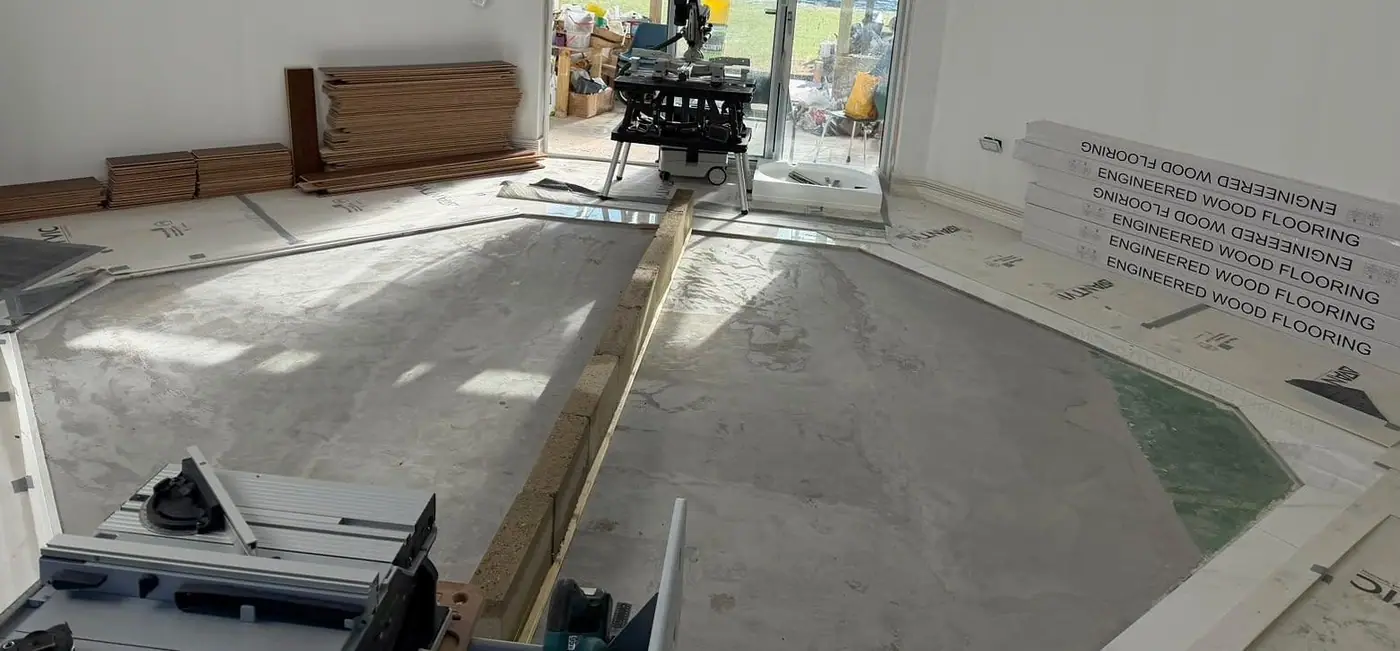
Prepared concrete base, boxes of engineered wood ready 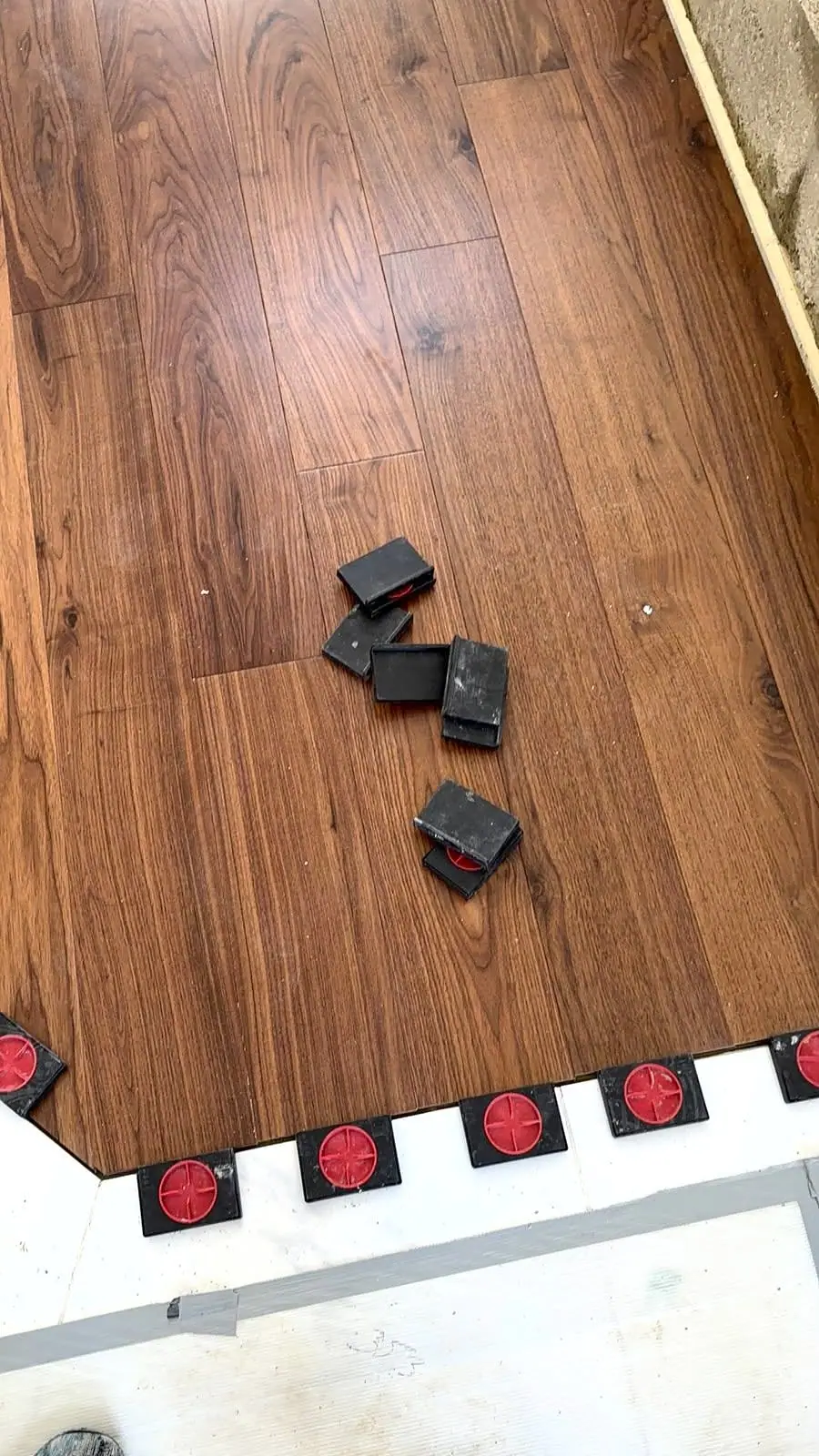
Walnut boards part-way through fitting, with edge spacers 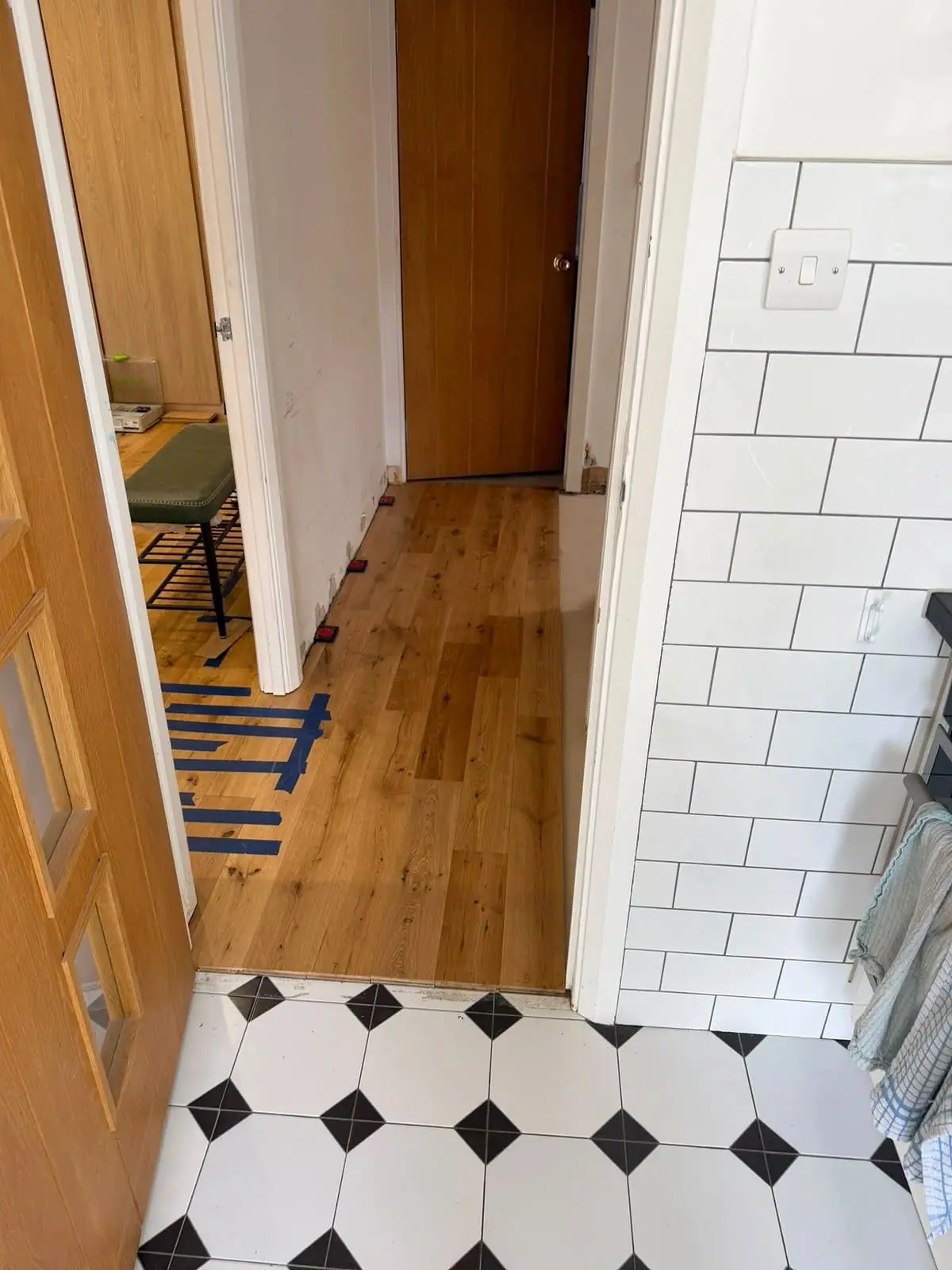
Oak planks along a hallway to a black-and-white tiled floor


Step by step
How the job runs
Look at the room and the subfloor
At the estimate
The subfloor is the surface under your new floor. It must be flat, firm and dry enough. If not, Alex levels or screeds it first.
Choose the boards and the fitting method
Before fitting day
You pick the board and finish, and Alex can supply it with matching underlay or adhesive and trims. The fitting method follows from the board and the subfloor.
Let the boards settle in the room
Before fitting day
The packs are left flat in the room so the boards match its temperature and humidity. The maker's instructions give the time.
Fit the boards
Day 1 onwards
Boards are laid from a straight line so the planks run true, and cut around doorframes and pipes. A typical room usually takes a day or two.
Expansion gaps and trims
Final stage
A small gap is left at every wall and fixed object, then hidden with skirting, scotia (a slim curved moulding) or threshold bars.
Clean-up and handover
Last day
The room is left tidy, and Alex walks you through the finished floor.
What is engineered wood flooring?
Engineered wood flooring is a board with a real wood top layer bonded to a core of layered ply or similar board. It looks like solid wood but is much more stable.
Solid wood swells and shrinks as heat and humidity change, which causes trouble over concrete or underfloor heating. The layers in an engineered core hold each other steady, so the board moves less. A concrete or screed floor must be dry enough first, and the maker's instructions set the limit.
How is engineered wood flooring fitted?
There are three ways: glued down to the subfloor, floating on an underlay, or secret-nailed to timber. The board's instructions and the subfloor decide which is used.
Gluing suits concrete and screed and passes heat well. A floating floor rests on underlay with its edges joined, so it goes down quickly on a flat floor. Secret-nailing fixes boards through the tongue into joists or ply, so no nail heads show.
Which size and finish of engineered wood is best?
Wide, long boards look modern and show fewer joints. Narrower boards suit smaller rooms and a traditional look. Longer boards need a flatter subfloor.
Lacquered boards have a hard clear coat that wipes clean easily. Oiled boards look more natural, with a soft matt feel. Brushed boards have a textured grain that hides marks. Look at samples in your own light.
Engineered wood or laminate?
Choose engineered wood if you want real timber underfoot and a floor that suits concrete or underfloor heating. It usually costs more than laminate, but it is the closer match to solid wood.
Laminate suits better when the budget is tight or the room is hard-used, such as a family hallway. Quick-Step makes both.
See laminate flooringWhat affects the cost of fitting engineered wood?
- The board you choose: width, length, species, finish and top layer thickness
- Room size and layout, including doorways, alcoves and cuts
- The fitting method, which changes the materials and time needed
- Whether the subfloor needs levelling or screeding first
- The underlay or adhesive and trims needed to finish the room
How to look after engineered wood flooring
Keep the room at a steady temperature, and bring underfloor heating up slowly. Small gaps between boards in dry winter air are normal wood movement.
Use felt pads under furniture and a doormat at the door, and lift heavy items rather than dragging them. Wipe up spills quickly.
Clean with a dry or lightly damp mop and a cleaner the maker recommends for your finish. Avoid steam mops.
Mistakes to avoid
- Fitting boards the day they arrive, without letting them settle in the room.
- Leaving no expansion gap at the walls, so the floor has nowhere to move.
- Laying over a concrete or screed floor that is not flat or dry enough.
- Fixing skirting down tight onto a floating floor, which stops it moving.
- Ordering exactly the room's area, with nothing extra for cuts and waste.
Common questions
Engineered wood flooring: common questions
Can engineered wood go over underfloor heating?
Yes, in most cases. Engineered wood is the usual choice over underfloor heating because its layered core moves less than solid wood. Check the board is approved for heated floors, and follow the maker's instructions for warming the floor slowly. Any underlay under a floating floor must also suit heating.
Can engineered wood be fitted on a concrete floor?
Yes. Engineered wood suits concrete better than solid wood because the layered core is more stable. The concrete or screed must be flat and dry enough first, and the board maker's instructions set the limit. If it is uneven, Alex can level or screed it before fitting.
How long should engineered wood settle in the room before fitting?
Leave the packs flat in the room where the floor will go, so the boards match its temperature and humidity. The board maker's instructions give the time, and it is usually days rather than hours. Fitting too soon is a common cause of gaps or lifting boards later.
Do engineered wood floors need an expansion gap?
Yes. Wood moves with the seasons, so a gap is left around the edge of the room and at pipes and thresholds. Skirting, scotia (a slim curved moulding) or trims then cover it. Without the gap, a floating floor can lift or buckle. The maker's instructions give the size.
Which finish is best: lacquered, oiled or brushed engineered wood?
Lacquered boards have a hard clear coat that wipes clean easily, so they suit busy kitchens and hallways. Oiled boards look more natural, with a soft matt feel. Brushed boards have a textured grain that hides marks. Choose by how the room is used, then look at samples in your own light.
How long does it take to fit engineered wood flooring?
It depends on the room size, the state of the base and the fitting method: whether the boards float, are glued or are nailed. Any levelling or ply boarding is done first. Alex gives you a realistic timeframe with his free estimate.

Free estimate
Get a free quote
Tell Alex about the job and get one clear, written price. Free, and no obligation.